

The Federal Government has released exposure draft legislation for the EV FBT changes announced in the 2026 Federal Budget. The proposal would progressively replace the current full FBT exemption with a permanent 25% discount.
Existing arrangements are proposed to be grandfathered, but material changes or replacement arrangements could cause that protection to be lost.
With the first major transition date of 1 April 2027 now approaching, employers and employees should understand both the opportunities and the risks.
Introduced from 1 July 2022, the Electric Car Discount generally exempts eligible electric cars provided through employers or novated leases from FBT. Following a statutory review, the Government decided to retain the incentive in a more targeted and financially sustainable form.
The 2026 Federal Budget therefore announced a phased reduction, now reflected in Treasury’s exposure draft legislation.
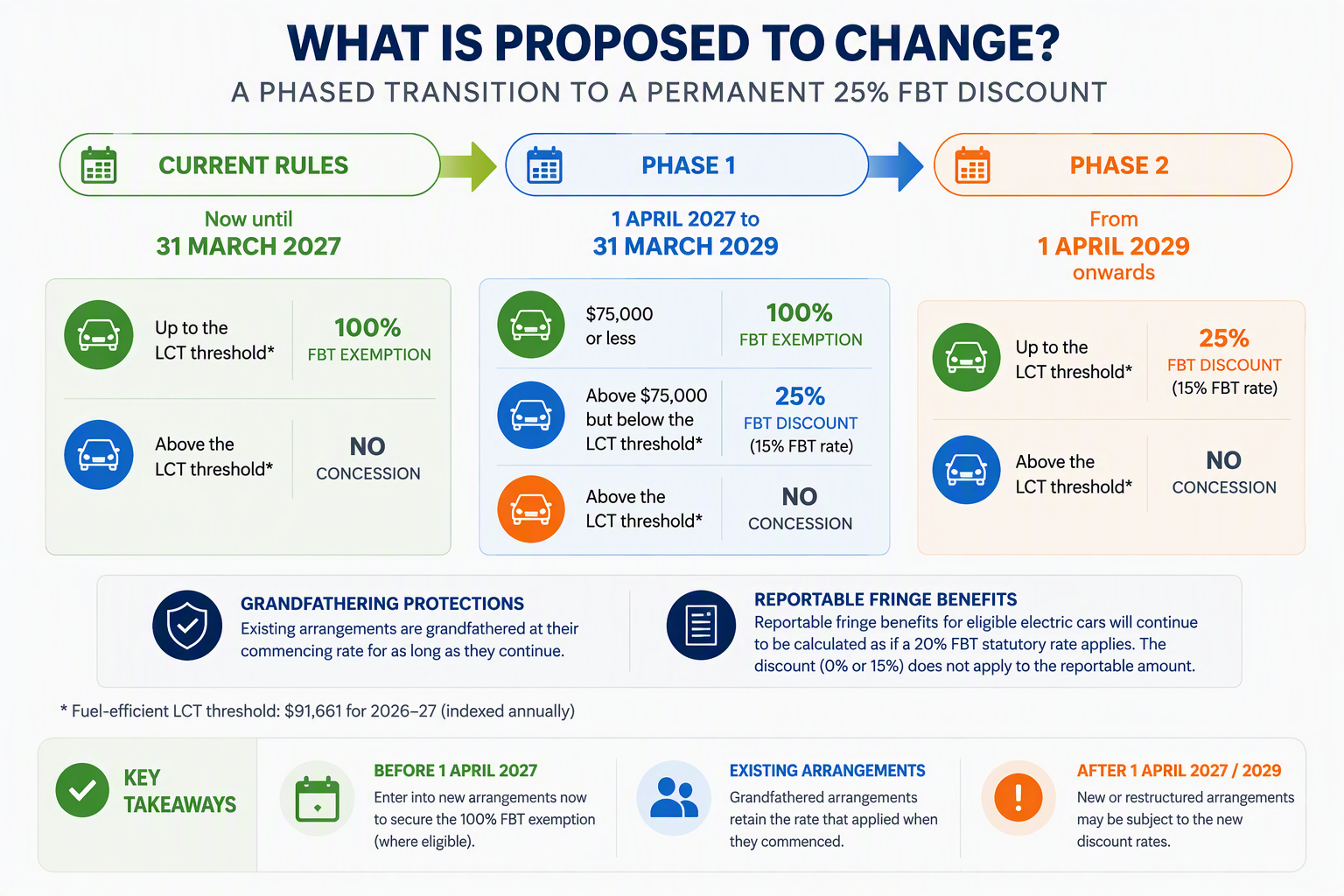
Reportable fringe benefits: Even where the discounted 15% FBT rate applies, the reportable fringe benefits amount is still calculated using the 20% statutory rate.
A key feature of the proposed legislation is grandfathering.
Treasury’s exposure draft distinguishes arrangements by vehicle value and timing. Eligible EVs valued at $75,000 or less may retain the full exemption where the commitment to provide the vehicle is entered into before 1 April 2029, while other applicable value thresholds and transition dates must also be checked. The ATO has indicated that existing leases will not be affected by the announced changes.
By contrast, new commitments entered into after the relevant transition date will generally qualify only for the reduced concession applying at that time.
Accordingly, many existing FBT-exempt novated leases may retain their tax benefits for the life of the arrangement.
Grandfathering may be lost after 1 April 2027 if the original commitment to provide the vehicle ends or is materially changed.
Although the legislation is not yet enacted, the following situations should be treated as risk areas.
A novated lease ordinarily depends on a specific employer and may terminate or require re-novation when employment changes. Moving to another employer can therefore end the original commitment and create a new post-transition arrangement, with a significant risk that grandfathering will be lost.
Refinancing, extending a lease, changing the residual or repayment schedule, or replacing the novation agreement may end the original commitment. Even changes presented as administrative variations should be reviewed as they may create a new arrangement.
Replacing one EV with another may create a new commitment; eligibility of the replacement vehicle alone does not preserve the original arrangement.
Terminating and re-entering an arrangement, even for a similar vehicle, may jeopardise grandfathering.
Commercially minor changes may still affect grandfathering. Tax-driven termination and recommencement arrangements may also attract the general anti-avoidance rules and ATO scrutiny.
The rules turn on whether a financially binding commitment to provide the vehicle remains in place—an issue that is not always straightforward.
The exposure draft continues to emphasise the existence and continuity of that commitment.
Clients should retain comprehensive records that establish when the commitment became binding, the parties and vehicle involved, and the enforceable obligations, including:
Employees seeking to maximise the current concession may have a limited opportunity to establish arrangements before the first transition date.
Practical steps to consider include:
The exposure draft is not yet enacted and may change. However, the policy direction is clear: the full EV FBT exemption is being progressively replaced by a permanent concessional regime.
Careful management of existing agreements may therefore be as important as securing the concession.
If you have an EV novated lease, are considering a new arrangement, or plan to change an existing one, obtain advice first.
Prosperity’s Smart Drive team can help assess whether your existing arrangement is likely to retain grandfathered status and assist with structuring future EV salary packaging arrangements in a tax-efficient manner.
This article is based on the Federal Budget 2026 announcement and Treasury’s exposure draft legislation. The measures discussed are proposed law only and may change before enactment.