The increased home charging rate is yet another reason to switch.
More Australians are choosing electric vehicles than ever before. With petrol prices hitting painful levels thanks to ongoing global oil uncertainty, it’s easy to see why so many drivers are making the switch. Running an EV is cheaper day-to-day, better for the environment, and, through a novated lease, can deliver serious tax savings.
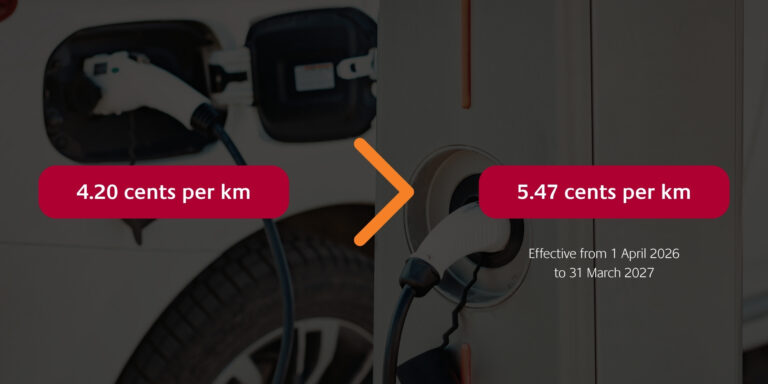
And now there’s one more piece of good news. As of 1 April 2026, the ATO’s EV home charging rate increased from 4.2 cents per kilometre to 5.47 cents per kilometre. This new rate applies for the FBT year ending 31 March 2027.
This rate is used to calculate your charging costs across every kilometre you travel (even if you’re charging at home using solar). No logbooks. No complicated electricity calculations. No digging through charging data.
Just submit your odometer reading at the end of the FBT year, and the benefit is calculated and returned to your nominated bank account.
Why does home charging need a special rate?
When you plug your EV in at home to charge, that electricity blends into your overall household power bill. There’s no easy way to separate our exactly how much electricity went into your car versus your fridge, lights, air conditioner, or other devices and appliances.
Rather than requiring you to install separate meters or dig through electricity bills, the ATO offers a simple shortcut: multiply the kilometres you’ve driven by the relevant rate, and that gives you an accepted estimate of your EV home charging costs. It’s a practical solution that removes the guesswork.
For example, if you drive 20,000km in a FBT year, this equates to a claim of $1140 at the new 5.47 cent per km rate (compared with just $840 at the old 4.2 cents per km rate).
Prefer a different approach?
The actual cost method is still available. If you expect to rely more on public charging or higher electricity costs, this option may allow you to claim a greater benefit based on your actual out of pocket costs.
Ready to make the most of your EV benefits?
Navigating the FBT rules and EV-related tax legislation can feel complicated, but it doesn’t have to be. At Prosperity Smart Drive, we help you structure your novated lease correctly from the start so you’re always using the right rates and claiming what you’re entitled to.
Get in touch with our team today to review your current arrangement or explore whether a novated lease is right for you. We’re here to make EV ownership simpler and smarter.